The Most Expensive Earbuds in the World Are Useless in the Wrong Ears
Every buying guide ranks earbuds by sound scores, noise cancelling ratings, and feature lists — and nearly every pair of disappointed ears is disappointed for a reason none of those rankings measure: the buds did not fit the one pair of ear canals they were actually bought for. Fit is not a comfort footnote; it is the acoustic foundation everything else is built on, because a broken seal leaks bass before any driver gets a vote, makes noise cancellation chase a problem fit already created, and decides whether the buds survive a run or a commute. Learning how to choose wireless earbuds therefore starts with the ear rather than the specification table: this guide walks the decision in the right order — fit and form factor first, then the audio chain explained in plain terms (drivers, Bluetooth codecs, and what your phone can actually use), the noise cancellation tiers and their honest trade-offs, and battery maths as it really works once the case is counted. It ends with a fifteen-minute fit-and-sound test you can run in any shop or within a returns window, and the checklist that matches the major brands’ differences to the way you will actually live with the things. It pairs with our explainer on how AI assistants work — the software intelligence in your pocket, matched here with the hardware that delivers its voice to your ear.
Fit First: Form Factors and the Seal That Decides the Sound
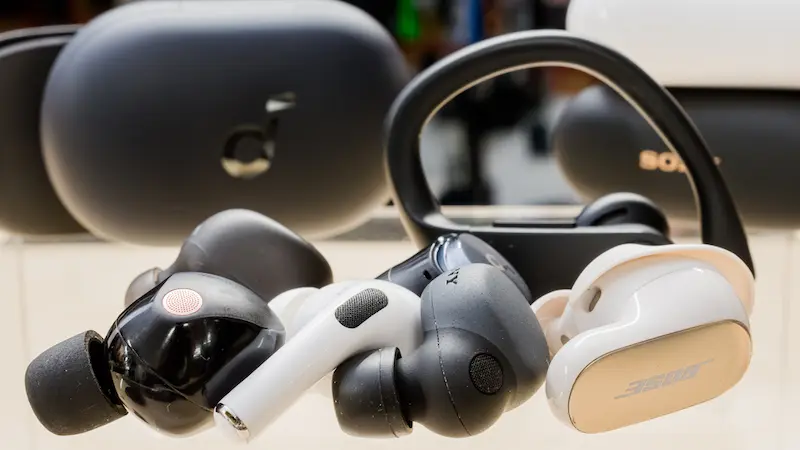
Three forms compete. Sealed in-ear buds (silicone or foam tips inserted into the canal) deliver the best sound isolation, the strongest bass, and the only platform on which premium noise cancellation fully works; their risk is comfort over long hours, which is decided by tip sizing — a good pair ships with several sizes, and the right size is the one that seals with a quarter-turn and stays sealed when you smile, chew, or jog in place, because the mouth moves the ears more than product pages admit. Semi-open buds (resting at the canal entrance, without a seal) trade bass and isolation for awareness and comfort — the right choice for office workers who must hear colleagues, runners who must hear traffic, and ears that cannot tolerate insertion — provided the buyer knows the trade is deliberate. Open-ear designs (clip, hook, or bone-conduction) sit outside the canal entirely, winning total awareness and unbeatable long-wear comfort for sport and outdoor work, while conceding most low-end sound. Beyond form, check three physical details: weight per bud (below roughly six grams disappears in the ear; above, fatigue arrives), control method (physical buttons work with gloves and wet hands; touch panels work when dry and misfire cheerfully in rain), and water resistance with real numbers — IPX4 shrugs off sweat and splashes, IPX5 and above survive genuine rain, and the rating that matters is the buds’ own, not the case’s. The fit test, performed whenever a trial or return window allows: wear them through one full album, a phone call while walking, and five minutes of your actual workout; buds that pass all three without adjustment have passed the only examination that will matter in month three.
The Audio Chain: Drivers, Codecs, and Your Phone’s Vote
With fit settled, the specification table earns a reading — in the order of what your ear can actually receive. Drivers (the tiny speakers, usually 6–11mm dynamic drivers in buds) are the part marketing bloats most: size and exotic materials matter less than tuning, the manufacturer’s choices about the sound signature, which is why two buds with identical driver specs can sound warm and veiled versus bright and thin; reviews describing the signature honestly are worth more than another millimetre, and an equaliser in the app can rescue a well-built bud whose default tuning is not yours. Bluetooth codecs decide the quality of the pipe between phone and bud: SBC is the universal floor (fine, unremarkable); AAC is the codec iPhones feed best, making it the sensible premium on Apple devices; LDAC and aptX variants raise the bitrate on Android flagships — with the honest caveat that the gain is subtle on earbuds, in motion, in noise, and vanishes entirely if your phone does not support the codec, so check your handset before paying for letters it cannot use. Noise cancellation tiers run from none, through passive isolation (fit alone), to the hybrid ANC of the flagship class, which genuinely deletes engine hum, cabin roar and office air-conditioning, while doing much less against voices and sudden sounds than the adverts imply; wind is ANC’s nemesis (microphones hear it as signal), transparency mode is the socially essential reverse gear, and strong ANC brings a real cost in battery and in a subtle pressure sensation some ears dislike — another reason the trial wear matters. Read the chain in order — fit, then tuning, then the codec your phone supports, then cancellation matched to your noise — and the flagship features sort themselves from the load-bearing ones.
Battery Maths, Case Logic, and the Final Checklist
Battery claims are the industry’s most creative writing, so translate them: the headline figure (often “up to 30 hours”) is buds-plus-case combined at moderate volume with ANC off, while the numbers that shape daily life are buds alone, with ANC on — typically four to eight hours on current models — and whether that covers your longest single stretch (a workday, a long-haul flight leg, an ultra-distance run are the honest tests) matters more than the combined total, because a case recharge is a pause, not a continuation. Valuable case features in order of real-world impact: fast charge (ten minutes buying an hour or more rescues more days than any other spec), wireless charging (a convenience that compounds if your phone and desk already speak it), USB-C (the port your cables already are), and find-my-buds support, because the most common earbud failure mode is not electronic — it is one bud, somewhere, gone. Now assemble the final decision: match form factor to your dominant use (sealed for commute and focus, semi-open for office and road awareness, open for long sport), confirm the codec your phone uses best, take ANC only to the tier your environment justifies, require bud-only battery above your longest session with margin, and spend the remainder of the budget on the brand whose app, warranty and tip selection you trust — because support and spares outlive spec-sheet victories. Then run the fifteen-minute test, in the shop or on day one at home: seal check with a smile and a chew, one bass-heavy track, one podcast for voices, one call outdoors, five minutes of your real movement. Earbuds are worn against the body for hours a day; they should be bought like shoes, not like televisions — fitted first, specified second, and chosen for the life you actually live in them.