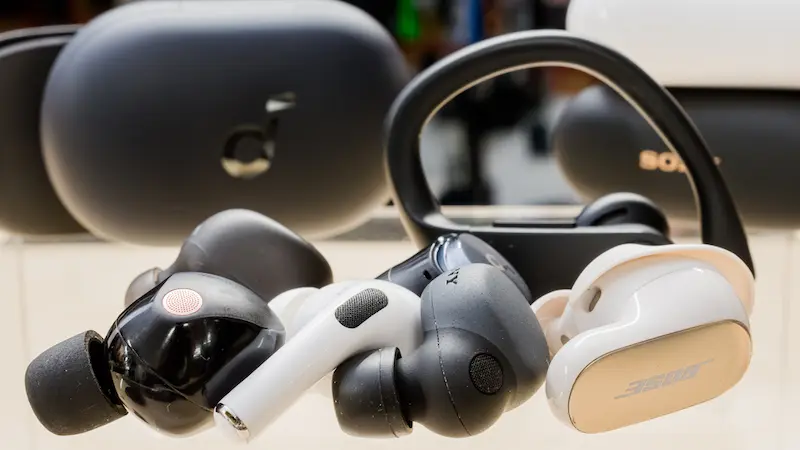
Wireless earbuds are the gadget almost everyone owns and almost everyone has bought badly at least once: the pair that hurt after twenty minutes, died before lunch, or sounded like a phone call from 1998. The market spans throwaway cheap sets and premium models costing as much as a phone, and spec sheets rarely predict which pair you will actually enjoy. This wireless earbuds buying guide organises the decision around what determines daily satisfaction — fit, battery, sound, noise control and call quality — so your next pair is chosen on evidence, not packaging.
Fit First: The Spec No Chart Can Show
Every recommendation in this wireless earbuds buying guide is secondary to fit, because earbuds that do not seal comfortably in your ears sound thin, fall out, and make their noise cancelling useless. Most quality sets include three or four tip sizes; memory-foam tips seal better for many people and are worth trying if silicone tips slip. Consider the two broad shapes: stem-style buds that sit lightly and suit smaller ears, and larger contoured buds that anchor more securely for sport. If possible, buy from a retailer with a genuine returns policy and test with your own ears for a full day — commuting, calls, a workout. Discomfort at minute ten becomes pain at hour two, and no amount of audio quality compensates. For runners and gym users, check the IP rating: IPX4 resists sweat and rain splashes; higher ratings survive heavier weather and rinsing.
Battery: Buds, Case and Realistic Numbers
Manufacturers quote battery life under laboratory conditions — moderate volume, noise cancelling off, one feature at a time. Real life combines all of them, so discount headline figures by roughly a third. What to look for: at least five to six honest hours per charge for the buds, a case holding three or more full recharges, and fast charging that returns an hour or two of playback from ten minutes in the case — the feature that rescues forgotten charges before a commute. Wireless charging for the case is a small luxury that becomes indispensable if your desk or nightstand already has a pad. Also check standby drain: some budget sets quietly empty themselves in the case over a week, a flaw reviews of long-term ownership expose and spec sheets hide. The same “total cost of ownership” thinking we apply across our coverage — see our guide to weighing free versus paid options honestly — applies here: a cheaper pair replaced twice costs more than one good pair kept for years.
Sound Quality and Codecs, Translated
Earbud sound is tuning plus fit, not driver size; a well-tuned small driver in a sealed ear beats a big driver wobbling loose. Most people prefer a slightly warm tuning with clear vocals, and the best insurance is an app with an equaliser so you can adjust to taste. Codec names do matter on Android: AAC serves iPhones well, while LDAC or aptX variants can carry more detail from compatible Android phones — but only if you listen to high-quality sources in quiet places; on a bus, convenience features outweigh codec purity. Call quality is the other half of audio and the half most reviews under-test: multiple microphones with wind reduction decide whether callers hear you or the street. If your job is calls, prioritise models praised specifically for voice clarity, and test on a breezy street, not a silent room.
Noise Cancelling: Know the Three Levels
This wireless earbuds buying guide separates noise control into three distinct things. Passive isolation is just the seal of the tips blocking sound physically — free and surprisingly effective. Active noise cancelling (ANC) uses microphones to cancel steady low-frequency noise — plane engines, train rumble, air conditioning — and the best implementations are transformative for travel and open-plan offices, while doing little for nearby voices. Transparency mode is the reverse: it pipes the world in so you can hear announcements and traffic without removing a bud. Judge ANC by your use: daily flyers should pay for the best; home workers may find passive isolation enough. Adaptive ANC that adjusts to your surroundings is convenient, but a strong fixed mode plus good transparency beats a mediocre adaptive system at the same price.
Features, Price and the Sweet Spot
Useful extras include multipoint connection (buds linked to phone and laptop simultaneously — a genuine productivity win), in-ear detection that pauses when you remove a bud, customisable controls, and a find-my-buds feature for the inevitable sofa-cushion incident. Gimmicks to discount: touch sliders you will trigger accidentally, and companion apps that demand accounts to change basic settings. On price, the sweet spot has settled firmly in the mid-range, where models from major brands deliver most of the flagship experience; beyond it, you pay for marginally better ANC, materials and brand ecosystems. Ecosystem lock-in cuts both ways — buds from your phone’s maker integrate beautifully (instant pairing, spatial audio, battery widgets) and are worth a premium if you are committed to that platform, as our platform comparison coverage, including our guide to choosing verified platforms and services, consistently concludes: compatibility with what you already own is a feature, not a footnote.
Care, Cases and Making Them Last
Earbuds live hard lives — pockets, gym bags, rain, the occasional washing-machine incident — so a few habits extend them considerably. Keep the case’s charging contacts clean with a dry cotton bud, since pocket lint is the leading cause of one bud mysteriously refusing to charge. Update firmware through the companion app; manufacturers quietly fix pairing bugs and battery drain that way. Store buds in their case rather than loose, both for protection and so the find-my feature can locate them. Replacement tips and batteries are the two wear items: foam tips compress and should be swapped every few months, and if a two-year-old set holds half its original charge, that is normal lithium ageing, not a defect. Bought well and kept decently, a good pair should serve three to four years — which is how the mid-range sweet spot earns its price.
Conclusion
Choose in this order: a fit your ears forget, battery that survives your longest day with the case as backup, tuning you can adjust, noise cancelling matched to your commute, and microphones that flatter your voice on calls. Follow this wireless earbuds buying guide and the pair you buy will be the pair you reach for every morning — which is the only review score that finally matters.